
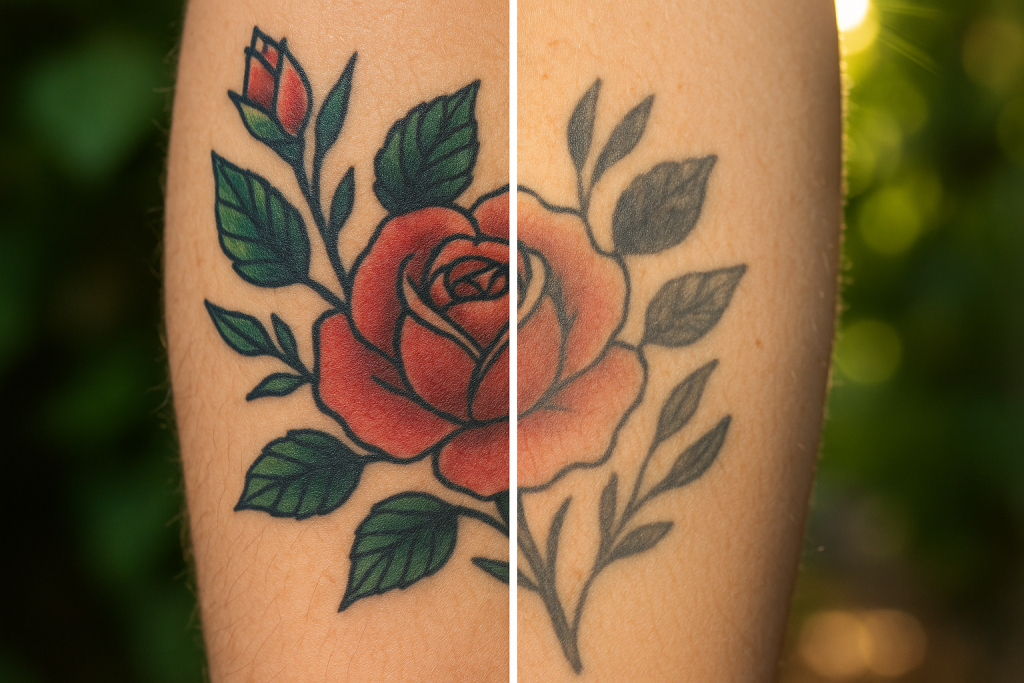
Short version: Sunlight is a chemist, lasers are hammers with PhDs, and your future self deserves an exit ramp. If you plan your tattoo with photochemistry and removal in mind, you’ll get richer color now and fewer headaches later. This isn’t about fear; it’s about being clever with biology, light, and design.
Not medical advice—just battle‑tested knowledge so you can ask sharper questions and make smarter choices.
1) Sunlight is a chemist (and it always gets a vote)
UV light doesn’t care how much you love your tattoo. It throws energy at pigments and sometimes knocks them apart into smaller molecules that scatter light differently—aka fading. Some pigments (especially certain azo reds/yellows) can break into aromatic amines, which toxicologists side‑eye for good reasons. This has been shown under UVB and even natural sunlight in lab and animal models. The risk is about degree and exposure, not instant doom—but it’s a real mechanism. (PubMed)
Practical translation: shade + sunscreen protect your art the same way they protect your collagen and DNA. Dermatologists recommend broad‑spectrum, water‑resistant SPF 30+, reapplied regularly once the tattoo has fully healed. During healing, keep it out of the sun entirely—cover, don’t coat. (American Academy of Dermatology)
2) Why some colors fade or fight you (and how to read that)
- Black usually ages best and is easiest to remove later. Carbon absorbs broadly, so both the sun and lasers “see” it clearly.
- Yellows, light blues, some greens tend to fade oddly in the sun and resist lasers because their absorption bands don’t line up with common wavelengths. Early clinic data and reviews have flagged greens/yellows and flesh tonesas stubborn, with titanium‑heavy inks over‑represented in poor laser responses. (JAMA Network)
Nerd note: “Green” isn’t one thing. Phthalocyanine greens/blues are famously durable on skin but can be laser‑stubborn; azo yellows may photo‑bleach and form breakdown products under sun or lasers. Different chemistry, different behavior. (PubMed)
3) Lasers 101 (without the techno‑babble)
Lasers remove ink by delivering short, high‑energy pulses that fracture pigment so your immune system can haul it away. Classic systems are Q‑switched (nanoseconds). Newer picosecond lasers blast faster, creating more of a shockwave effect, which can help tough colors and reduce collateral heat. Evidence keeps stacking up that pico often clears ink in fewer sessions than older systems. (PubMed)
Skin tone matters because melanin also absorbs light. For melanin‑rich skin, the 1064 nm Nd:YAG wavelength is the workhorse—deeper penetration, less melanin absorption, and better safety margins. Case series and comparative studies support this approach; conservative settings and test spots are your friends. (PMC)
4) The weird bit: when lasers make pale ink darker
Yes, it happens. Paradoxical darkening can strike white/skin‑tone and some red/brown cosmetic inks that contain titanium dioxide and iron oxides. Instead of shattering into dust, those pigments can change valence state and turn gray/blue under certain laser wavelengths. It’s rare, it’s maddening, and there are strategies (alternate wavelengths, ablative lasers, staged approaches), but you want a specialist at the controls. (JAMA Network)
5) What actually breaks inside the ink (and why you should care)
When lasers hit organic pigments, you don’t just get smaller chunks—you can get new chemicals. A striking lab example: phthalocyanine blue (a common blue/green family) produced hydrogen cyanide in measurable amounts under ruby‑laser conditions. That doesn’t mean your removal session equals a cyanide bath; it means trained clinicians use ventilation and safety protocols for the laser plume, and you should insist on them. Bigger picture: both sunlight and lasers can generate aromatic amines and other by‑products in some azo pigments. In short, the chemistry is real—pick artists and clinics who respect it. (Nature)
6) Design now with an exit ramp later
You can future‑proof your tattoo without sacrificing oomph. A few field‑tested tactics:
- Placement vs. sun: If a piece must live on a UV‑heavy zone (forearms, hands, neck), plan bolder contrast, fewer pastels, and commit to lifelong SPF habits after healing. (American Academy of Dermatology)
- Color strategy: Anchor with black frameworks (lines or shading) so fading colors don’t leave a ghost. If you love tricky colors (yellows, teals), use them as accents, not the entire field. (JAMA Network)
- Negative space & readable shapes: High‑contrast silhouettes age better and are easier to target with lasers if you ever need a cover‑up or partial fade.
- Avoid over‑saturation bricks: Wall‑to‑wall heavy packing looks smooth on day one but can take more sessions to move later. Think layers and breathable zones.
- Think “cover‑up geometry”: If you may pivot in five years, leave lanes where a future artist can weave new forms without scorched‑earth removal.
7) Aftercare that actually protects color (and future you)
- Healing window: Keep it out of the sun, avoid soaking, and follow your artist’s aftercare. No sunscreen until it’s fully healed, then SPF 30+ whenever it sees daylight. Clothing beats chemicals during those early weeks. (PMC)
- Long‑term: Moisture + shade + reapplying sunscreen beat any “tattoo‑specific” miracle goop. Broad‑spectrum SPF 30+ is the boring answer because it works. (American Academy of Dermatology)
8) Quick answers for common “but what about…?” moments
- “Are picosecond lasers always better?” Often, yes—especially for blues/greens—and many clinics now use mixed wavelengths per color. But operator skill trumps hardware hype. (PubMed)
- “I’m dark‑skinned—can I remove a tattoo safely?” Yes, with the right hands and 1064 nm Nd:YAG‑basedstrategies, staged conservatively. Ask to see healed results on your skin type. (PMC)
- “Why did my friend’s beige brow tattoo turn slate?” Likely titanium/iron chemistry under the laser. There are workarounds, but it’s a specialist job. (ASLMS)
9) The take‑home checklist (save this for your next consult)
For clients
- Decide your sun reality: office goblin or beach person? Your palette and placement should match. (American Academy of Dermatology)
- Ask which pigments and CI codes will be used; keep a photo of the bottle labels.
- Commit to aftercare and sun habits after healing—future you will thank you. (PMC)
For artists
- Build with contrast and negative space so the design ages and edits well.
- Reserve finicky colors for accents; lay a black scaffold. (JAMA Network)
- Educate clients about paradoxical darkening risk in whites/skin‑tones and route to experienced removers if needed. (ASLMS)
- Keep a Pigment Log (brand, color name, batch, CI code) for serious pieces; it’s gold if removal or allergy questions pop up later.
Sources worth your eyeballs
- UV/sunlight can cleave certain pigments (aromatic amines): Engel et al. (2007); overview of degradation products across sunlight/laser. (PubMed)
- AAD guidance on caring for tattooed skin + sunscreen; no sunscreen until healed (aftercare review). (American Academy of Dermatology)
- Stubborn colors & titanium link; early clinical laser experience. (JAMA Network)
- Paradoxical darkening of skin‑tone inks; management caveats. (Wiley Online Library)
- Laser chemistry: HCN from phthalocyanine blue under ruby laser; other laser‑induced breakdown products. (Nature)
- Safer wavelengths and strategies for melanin‑rich skin; comparative data on pico vs nano. (PMC)
Wrap‑up
Tattoos live in the real world—with sun, seasons, and changing taste. The trick is to design for delight today and engineer for options tomorrow. Pick colors with intent, place them where they’ll thrive, and partner with artists and clinics who treat light like a tool, not a toy. Share this with the friend who’s planning a full‑color forearm and the one quietly googling “tattoo removal near me.” Both deserve good science and great art.